University Virtual Tours for International Students
International students represent a significant enrollment segment for universities — and they face the biggest barriers to campus visits. A virtual campus tour is often the primary way international prospects evaluate your institution before applying.
Why International Recruitment Needs Virtual Tours
The Distance Problem
An international student in India, China, Brazil, or Nigeria cannot easily visit 5-10 U.S. universities before applying. Application decisions are often made entirely from online research. A university with a compelling virtual tour has a measurable advantage over one with only photos and descriptions.
The Financial Commitment
International students pay full tuition — often $30,000-$60,000+ per year. This investment demands confidence in the institution. A virtual tour provides visual evidence of campus quality that helps families justify the financial commitment.
International student revenue is critical for many universities, particularly those facing declining domestic enrollment. A single international student may generate $120,000-$240,000 in tuition revenue over a four-year degree program. When you consider that a comprehensive virtual campus tour typically costs $2,000-$5,000 as a one-time investment, the math is straightforward: converting even one additional international student through a virtual tour yields a 25-100x return on that investment. Few marketing tools in higher education offer that kind of leverage.
The virtual tour also reduces a common friction point in international recruitment — the “sight unseen” anxiety that leads families to choose a university they have physically visited over one they have only read about online. By providing an immersive walkthrough experience, universities can compete on campus quality even when prospective students cannot travel for an in-person visit.
Time Zone Independence
Your admissions office keeps U.S. business hours. Your virtual tour is available in every time zone, 24/7. A student in Seoul can explore your campus at 2 AM Eastern time — and make a decision that leads to $200,000+ in lifetime tuition revenue.

Key Spaces for International Student Recruitment
- Admissions center — The first touchpoint in the enrollment journey
- Residence halls — Living conditions matter enormously to families sending children abroad
- Dining facilities — Food quality and variety, including international cuisine options
- Student center — Social life and community building
- International student services office — Demonstrate dedicated support
- Library and study spaces — Academic environment quality
- Recreation and athletic facilities — Campus life beyond academics
- Signature academic spaces — Labs, studios, and facilities specific to popular programs
Strategies for International Markets
Embed in Country-Specific Landing Pages
If you have landing pages for Chinese, Indian, or other international markets, embed the virtual tour prominently. The tour transcends language barriers — a student may not read your English copy fluently, but they can navigate the 3D walkthrough.
Share with Recruitment Agents
International recruitment agents recommend universities to families. Give agents direct links to your virtual tour for use in presentations and family consultations.
Feature in Virtual Fair Booths
International education fairs have moved partially online. A virtual tour is a powerful asset in virtual fair presentations, allowing real-time guided walkthroughs for groups of prospective students.
Include in Offer Letters
When a student receives an acceptance letter, include a virtual tour link. The tour reinforces the decision and helps convert admitted students to enrolled students — reducing yield melt.
Analytics and Tracking
One of the most underutilized advantages of Matterport virtual tours is the analytics data they provide. Unlike a photo gallery or a video walkthrough, a 3D virtual tour generates actionable engagement data that admissions teams can use to refine their recruitment strategy.
Matterport’s analytics dashboard tracks several key metrics:
- Total views — How many people opened your tour in a given time period
- Average time spent — How long visitors engage with the 3D walkthrough (longer sessions indicate stronger interest)
- Most-viewed spaces — Which rooms and areas generate the most attention, helping you understand what matters to prospective students
- Geographic location of viewers — Where in the world your tour is being accessed, broken down by country and region
This geographic data is particularly valuable for international recruitment. If your analytics show strong engagement from South Korea but minimal views from Brazil, your admissions team can adjust outreach accordingly — perhaps investing more in Korean recruitment fairs or partnering with additional agents in Seoul while investigating why Brazilian engagement is low.
Universities can also correlate tour engagement data with application metrics. If tour views spike after an email campaign to admitted students in India, and those students subsequently enroll at a higher rate, you have evidence that the virtual tour is contributing to yield. This kind of data-driven insight helps justify continued investment in virtual tour content and informs decisions about which spaces to scan next.
Mobile Experience
For international student recruitment, mobile compatibility is not a nice-to-have — it is essential. In many of the markets where universities recruit most actively, mobile devices are the primary way people access the internet.
Matterport tours are fully mobile-responsive and work directly in any modern web browser. There is no app to download, no special software to install, and no high-end hardware required. A student in Lagos, Ho Chi Minh City, or Jakarta can explore your campus on the same smartphone they use for everything else.
This matters because mobile internet usage patterns vary significantly by region. In Southeast Asia and Sub-Saharan Africa, mobile phones are often the only internet-connected device a family owns. A virtual tour that requires a desktop browser or a dedicated app effectively excludes a significant portion of your international prospect pool. Matterport’s browser-based approach removes that barrier entirely.
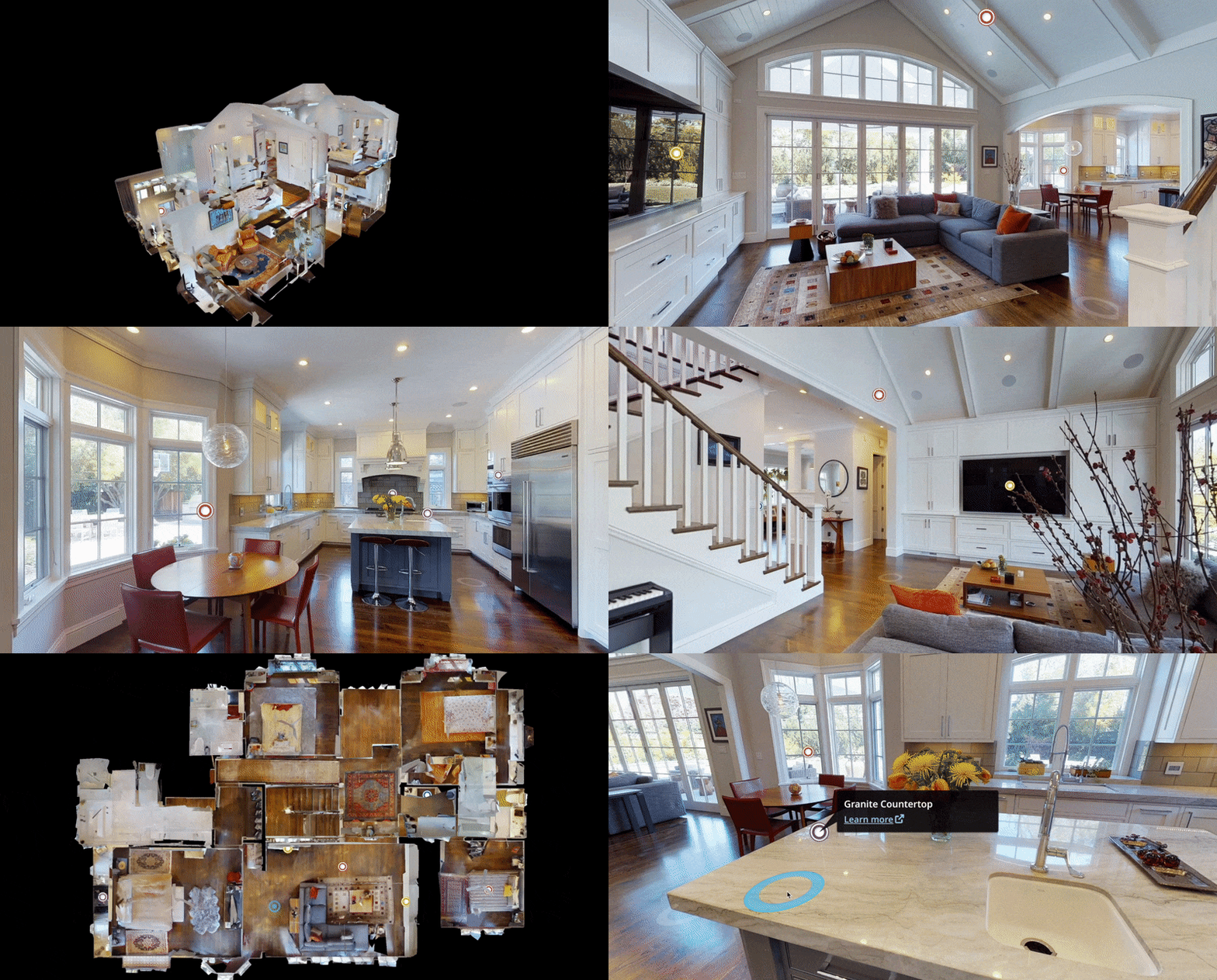
The mobile experience preserves the core functionality of the tour — students can navigate through spaces, zoom in on details, view information tags, and switch between dollhouse view and walkthrough mode. Touch-based navigation is intuitive, and load times are optimized for mobile connections. A prospective student browsing on a 4G connection in Manila gets the same core experience as someone on a fiber connection in London.
Accessibility Features
Virtual campus tours also address accessibility needs that traditional in-person tours often cannot. For prospective students and families with disabilities, navigating a multi-building campus during an in-person tour can present significant challenges — uneven terrain, stairs, long walking distances between buildings, and limited seating.
A virtual tour provides equal access to campus information regardless of physical ability. Matterport tours support keyboard navigation, allowing users who cannot use a mouse or touchscreen to move through spaces using standard keyboard controls. When information tags are properly configured with descriptive alt text, screen readers can convey the content of each annotated point to visually impaired users.
Tours can also include audio descriptions and translated text overlays on information tags, making content accessible to users who need auditory reinforcement or who speak languages other than English. For universities recruiting in multilingual markets, adding translated information tags to key spaces — the admissions office, the international student center, housing — can significantly improve comprehension for families who are not fluent in English.
ADA compliance considerations are built into the Matterport platform’s design. The web-based viewer meets WCAG guidelines for contrast, keyboard operability, and screen reader compatibility. For universities that are committed to accessibility in their digital presence, a virtual tour extends that commitment to the campus exploration experience.
Getting Started
University virtual campus tours typically cover 8-12 key spaces, with pricing starting at $2,000. A phased approach allows you to expand coverage over time.
Learn more at our Universities & Colleges page.
Ready to reach international students? Get a free quote for your campus virtual tour.
Related resources:
Ready to Start Your Project?
Get a free quote and consultation from our 3D scanning experts.
Get Your Free Quote