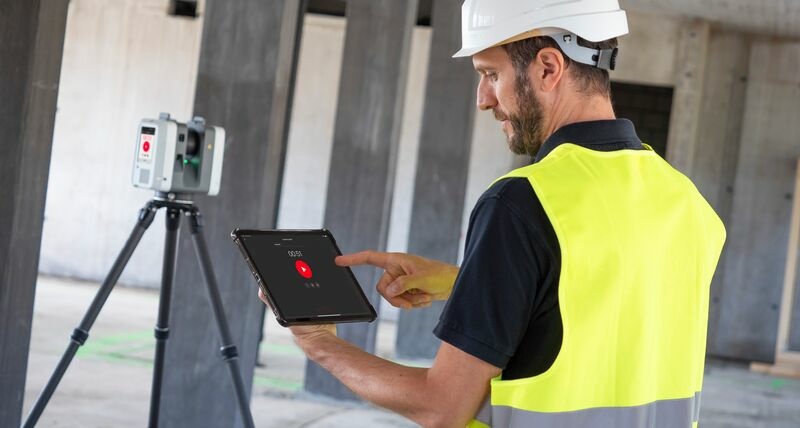
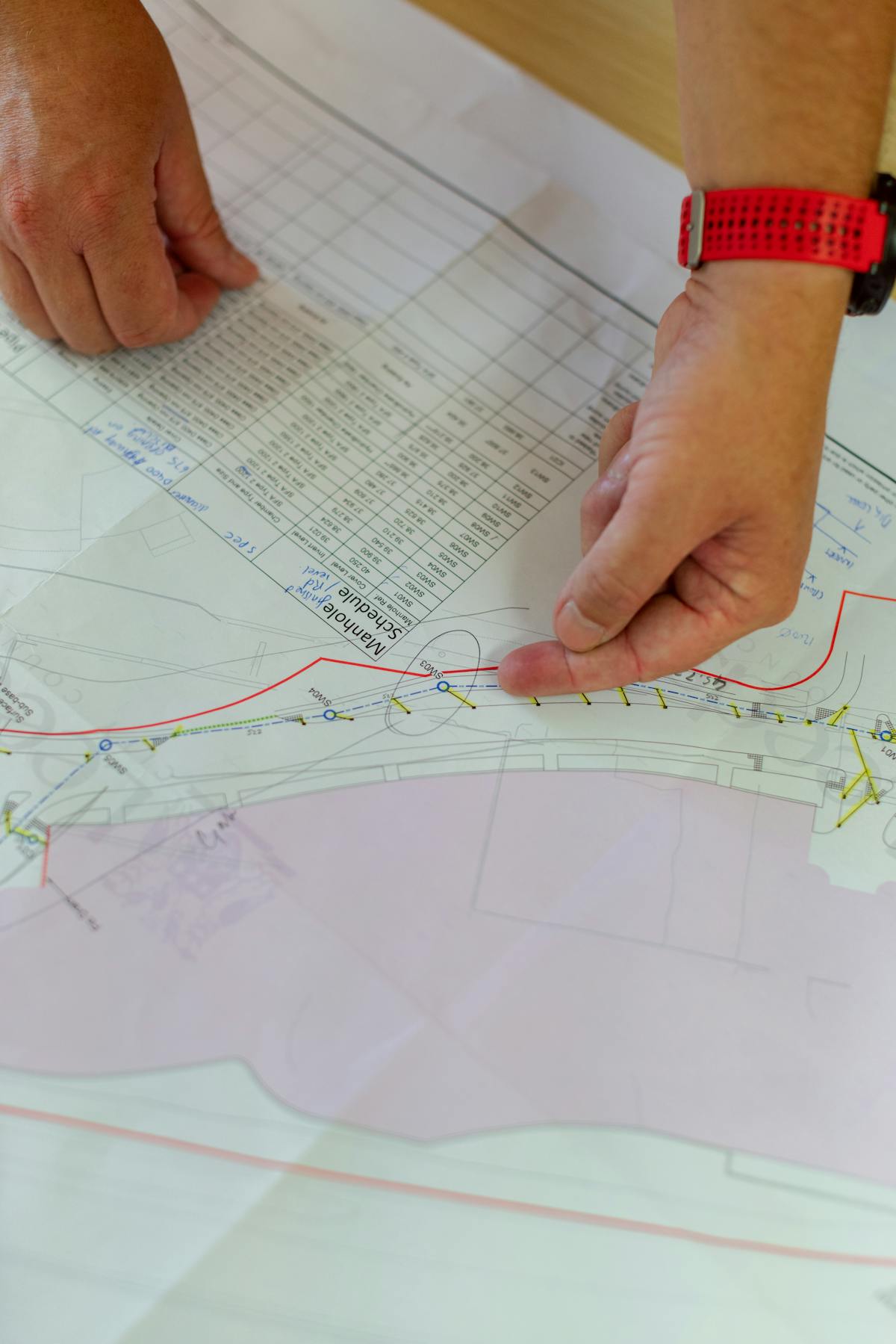
You have commissioned a 3D laser scan of your construction site. The scanner captures millions of points per second with millimeter-level precision. But when your engineer opens the point cloud file, the data does not align with the project coordinate system. The building is in the wrong location. The elevations are off. The data cannot be used for design, permitting, or construction verification.
This is what happens when 3D scanning is performed without survey control points. The scanner captures geometry accurately relative to itself, but without external reference, that geometry floats in arbitrary space. Survey control is what ties your 3D scan data to the real world.
What Are Survey Control Points?
Survey control points are physical markers placed at known, precisely measured locations on or near a project site. A licensed land surveyor establishes these points using high-precision equipment (total stations, GNSS receivers, or a combination) and ties them to a recognized coordinate system — typically State Plane Coordinates or UTM in the United States.
For 3D scanning projects, these control points serve as reference targets that allow the scanning team to register and georeference the point cloud data. The result is a point cloud where every measurement corresponds to a real-world coordinate with known accuracy.
Components of a Control Network
A typical survey control network for a 3D scanning project includes:
- Primary control points — At least 3-4 points establishing the project coordinate system, set by a licensed surveyor with GNSS or traverse methods. These form the backbone of the control network.
- Scan targets — Spheres, checkerboard targets, or tilt targets placed at surveyed positions. The scanning team uses these to register individual scans and tie them to the control network.
- Benchmarks — Vertical control points tied to a known datum (NAVD88 in the US). Critical for projects where elevation accuracy matters — drainage design, flood zone compliance, and grading.
- Checkpoints — Additional surveyed points used to verify accuracy after registration. These are not used in the registration process itself, so they provide an independent quality check.
When You Need Survey Control
Not every 3D scanning project requires a full survey control network. The decision depends on how the data will be used downstream.
Survey Control Required
- Construction documentation — As-built models for permitting, engineering review, or construction verification must be in the project coordinate system.
- Design coordination — If the point cloud will be used alongside CAD or BIM models, it must share the same coordinate system and datum.
- Regulatory compliance — Permit submittals, FEMA elevation documentation, and code compliance reviews require survey-grade georeferenced data.
- Multi-phase scanning — Projects scanned over weeks or months need a common control network to merge datasets accurately.
- Integration with site surveys — If your engineer has a topographic survey, boundary survey, or utility survey, the 3D scan must align with that data.
Survey Control Optional
- Interior visualization — Virtual tours, marketing walkthroughs, and space planning typically do not need real-world coordinates.
- Relative measurements — If you only need dimensions within a space (room sizes, equipment clearances), relative accuracy is sufficient.
- Standalone documentation — Historic preservation scanning or condition assessments where the data is self-contained.
How Georeferencing Works
Georeferencing is the process of transforming a 3D scan from the scanner’s local coordinate system to a real-world coordinate system. Here is how it works in practice:
Step 1 — Survey control established. Before scanning begins, a licensed surveyor places and measures control points and scan targets. The surveyor provides coordinates for each target in the project coordinate system.
Step 2 — Scanning with targets visible. The scanning team positions the laser scanner so that multiple control targets are visible in each scan position. The scanner captures the targets along with the rest of the scene.
Step 3 — Target identification. In the registration software, the scanning team identifies the control targets in each scan. The software extracts the target center coordinates from the point cloud data.
Step 4 — Registration and transformation. The software computes a best-fit transformation that aligns the scan target positions with the surveyed coordinates. This transformation is applied to the entire point cloud.
Step 5 — Accuracy verification. Checkpoints are compared against the registered point cloud. The difference between surveyed checkpoint positions and the corresponding point cloud positions is the registration error. For most construction applications, this should be within 6mm (1/4 inch) or better.
Common Coordinate Systems
In the United States, the most common coordinate systems for construction 3D scanning are:
- State Plane Coordinate System (SPCS) — The standard for most construction projects. Each state is divided into zones. Florida has three zones: North (0901), East (0902), and West (0903).
- UTM (Universal Transverse Mercator) — Common for larger-area projects and federal work. Florida spans UTM zones 16 and 17.
- Local site coordinates — Some projects use an arbitrary local system established by the project surveyor. This is common for smaller sites where state plane is unnecessarily complex.
The choice of coordinate system should match what your engineer and contractor are using for design and construction documents. Mismatched coordinate systems are a common source of alignment errors.
Accuracy Considerations
Survey control accuracy directly affects your point cloud accuracy. The total positional accuracy of a georeferenced point cloud is a combination of:
- Control network accuracy — How precisely the surveyor established the control points. Modern GNSS and total station methods typically achieve 5-10mm accuracy for project control.
- Scan-to-control registration accuracy — How well the scanner targets align with the surveyed coordinates. Typical registration accuracy is 2-6mm.
- Individual point accuracy — The scanner’s inherent measurement accuracy. Modern construction-grade scanners achieve 1-3mm ranging accuracy.
For most construction applications, the combined accuracy of a properly controlled 3D scan is 10-15mm (roughly 1/2 inch). This meets or exceeds the requirements for as-built documentation, construction verification, and most design applications.
Getting Survey Control for Your Project
If your project requires georeferenced 3D scan data, you need a licensed land surveyor to establish the control network before scanning begins. The surveyor should:
- Coordinate with the scanning team on target type and placement
- Establish primary control tied to the project coordinate system
- Set scan targets at positions visible to the scanner
- Provide a survey control report with coordinates, datum, and accuracy statements
For Florida projects, Apex Surveying & Mapping provides survey control services for 3D scanning projects across all 67 counties. They handle control network design, target placement, and coordinate delivery in whatever system your project requires.
Timeline and Cost
Survey control work typically takes 1-2 days on site, with the control report delivered within a week. Costs vary by project complexity:
- Small site (single building): $1,500 - $3,000 for control network
- Medium site (campus or multi-building): $3,000 - $8,000
- Large site (infrastructure, highway, utility corridor): $5,000 - $15,000+
These costs are separate from the 3D scanning service. While it adds to the project budget, survey control is significantly cheaper than re-scanning an entire project because the original data could not be used.
Key Takeaways
Survey control is not optional for engineering-grade 3D scanning. It is the foundation that makes your point cloud data usable for design, permitting, and construction. Without it, you have a beautiful but unusable dataset.
Plan for survey control at the start of your project — not as an afterthought. Coordinate between your surveyor and scanning team early. The cost of survey control is a fraction of the scanning cost, and it prevents the much larger cost of redoing work with unusable data.
Ready to Start Your Project?
Get a free quote and consultation from our 3D scanning experts.
Get Your Free Quote