Mobile SLAM scanning has changed the economics of 3D building documentation. Projects that once required a week of tripod-based field work can now be captured in a day, and that speed difference translates directly to cost savings for clients. But understanding what mobile scanning actually costs — and what drives those costs up or down — requires more detail than a single per-square-foot number.
This guide breaks down mobile SLAM scanning costs by project type, explains the factors that affect pricing, compares mobile and tripod scanning economics, and provides sample calculations so you can estimate costs for your specific project.
Mobile SLAM Scanning Price Ranges by Project Type
Mobile SLAM scanning costs vary significantly based on project scale, complexity, and deliverable requirements. The following ranges are based on typical service provider pricing in the U.S. market.
Commercial Buildings
| Project Size | Typical Cost Range | Per-Sqft Rate |
|---|---|---|
| Small office (5,000-20,000 sqft) | $3,000 - $8,000 | $0.40 - $0.70 |
| Medium commercial (20,000-100,000 sqft) | $6,000 - $25,000 | $0.25 - $0.50 |
| Large commercial (100,000-500,000 sqft) | $20,000 - $60,000 | $0.20 - $0.40 |
| Campus (500,000+ sqft) | $50,000 - $150,000+ | $0.20 - $0.30 |
Commercial projects include offices, retail spaces, hotels, hospitals, educational facilities, and mixed-use buildings. The per-square-foot rate decreases with project size because mobilization costs (travel, equipment setup, project management) are spread across more square footage.
Industrial Facilities
| Project Size | Typical Cost Range | Per-Sqft Rate |
|---|---|---|
| Small industrial (under 50,000 sqft) | $10,000 - $20,000 | $0.30 - $0.70 |
| Medium industrial (50,000-200,000 sqft) | $15,000 - $45,000 | $0.25 - $0.50 |
| Large industrial (200,000-500,000 sqft) | $35,000 - $80,000 | $0.20 - $0.40 |
| Mega facility (500,000+ sqft) | $70,000 - $200,000+ | $0.20 - $0.35 |
Industrial projects include warehouses, distribution centers, manufacturing plants, data centers, and processing facilities. Industrial pricing tends toward the higher end of per-sqft ranges due to access complexity, safety requirements, and multi-level mezzanines.
Minimum project costs:
- Commercial: $3,000 minimum
- Industrial: $10,000 minimum
- Single small space: $1,000 minimum
Specialized Applications
Some project types fall outside standard per-sqft pricing:
| Application | Typical Cost Range | Pricing Basis |
|---|---|---|
| Retail portfolio (10+ locations) | $2,000 - $5,000 per store | Per-location |
| Hotel documentation (100+ rooms) | $15,000 - $40,000 total | Per-property |
| Parking structure | $5,000 - $15,000 per level | Per-level |
| Construction progress monitoring | $3,000 - $8,000 per visit | Per-visit |
What Drives Mobile Scanning Costs
The per-square-foot ranges above are broad because several factors push costs higher or lower within those ranges. Understanding these factors helps you estimate where your project will fall.
Factors That Increase Cost
Facility complexity. A 100,000-square-foot warehouse with 40-foot clear heights and straight aisles is simpler to scan than a 100,000-square-foot hospital with hundreds of rooms, corridors, mechanical spaces, and multiple floors connected by elevators and stairwells. Complex geometry requires more careful walk planning, more loop closures, and longer processing time.
Access constraints. If scanning must happen during off-hours (nights, weekends), in secure environments requiring escorts, or in active industrial facilities with safety protocols, the additional coordination and scheduling costs are reflected in pricing.
Multi-level buildings. Each additional floor adds scan time proportional to its area, plus transition time between levels. Buildings with complex vertical connections (mezzanines, split levels, atria) require more careful SLAM strategy than simple stacked floors.
Deliverable scope. A basic point cloud delivery is the most economical option. Adding floor plan extraction, clearance mapping, 3D mesh generation, virtual walkthrough hosting (NavVis IVION or similar), or specialized analysis increases the processing and production time.
Geographic location. Scanning services in major metropolitan areas (New York, San Francisco, Chicago) typically cost more than in smaller markets due to higher operating costs, travel logistics, and local demand.
Hybrid requirements. If certain areas of the project require tripod scanning for higher accuracy (mechanical rooms, structural elements, critical tolerances), the addition of terrestrial scanning adds equipment, field time, and processing complexity.
Factors That Decrease Cost
Volume and repeat work. Multi-building portfolios, ongoing contracts, and repeat engagements generally qualify for reduced per-sqft rates. Scanning 10 retail locations under a single contract costs less per location than 10 separate one-off projects.
Simple geometry. Open-plan spaces with minimal interior partitions (warehouses, exhibition halls, open offices) scan faster and process more efficiently than complex, compartmentalized spaces.
Flexible scheduling. Projects with flexible timelines allow the scanning provider to optimize their crew scheduling, potentially reducing mobilization costs.
Point cloud only. If the deliverable is limited to a registered, cleaned point cloud without additional products (floor plans, analysis, hosting), the processing and production phase is shorter and less expensive.
Mobile SLAM vs. Tripod Scanning: Cost Comparison
The cost advantage of mobile SLAM scanning over traditional tripod-based scanning is one of its primary selling points. Here is how the economics compare across different project sizes.
Field Time Comparison
| Facility Size | Tripod Field Time | Mobile Field Time | Time Savings |
|---|---|---|---|
| 20,000 sqft | 1-2 days | 2-3 hours | 75-85% |
| 100,000 sqft | 4-6 days | 1 day | 80-85% |
| 300,000 sqft | 10-15 days | 2-3 days | 75-80% |
| 1,000,000 sqft | 30-45 days | 5-8 days | 80-85% |
Field time is the largest single cost driver in scanning projects. The operator, equipment, travel, and per-diem costs all scale with time on site.
Cost Comparison
| Project Size | Tripod Cost | Mobile Cost | Savings |
|---|---|---|---|
| 20,000 sqft office | $8,000 - $14,000 | $4,000 - $8,000 | 40-50% |
| 100,000 sqft building | $30,000 - $50,000 | $15,000 - $30,000 | 40-50% |
| 300,000 sqft warehouse | $60,000 - $100,000 | $25,000 - $50,000 | 50-60% |
| 1M sqft campus | $200,000 - $350,000 | $80,000 - $150,000 | 55-65% |
The savings percentage increases with project size because mobile scanning’s speed advantage compounds across larger areas. On small projects (under 10,000 sqft), the cost difference narrows because mobilization is a larger share of total cost.
When Tripod Scanning Is Worth the Extra Cost
Despite the cost premium, tripod scanning delivers value that mobile SLAM cannot match in specific situations:
- Accuracy-critical applications requiring sub-5mm precision (construction QA/QC, structural analysis, mechanical documentation)
- Point density-critical applications where every small-diameter pipe, conduit, and fitting must be captured with full geometric detail
- Legal and regulatory documentation where the documented precision of tripod scanning provides stronger evidentiary value
- Small projects (under 10,000 sqft) where the cost difference is minimal and accuracy matters
The Hybrid Approach: Optimizing Cost and Quality
Many projects benefit from a hybrid approach that uses both mobile and tripod scanning:
- Mobile SLAM captures the general facility: corridors, offices, retail areas, warehouses, common spaces
- Tripod scanning captures critical zones: mechanical rooms, server rooms, structural elements, areas with tight tolerances
This approach typically costs 40-60% of a full tripod scan while achieving tripod-grade accuracy where it matters most.
Sample Project Cost Calculations
The following examples illustrate how mobile scanning costs are calculated for typical projects.
Example 1: 150,000 sqft Office Building
- Scope: 6 floors, approximately 25,000 sqft per floor
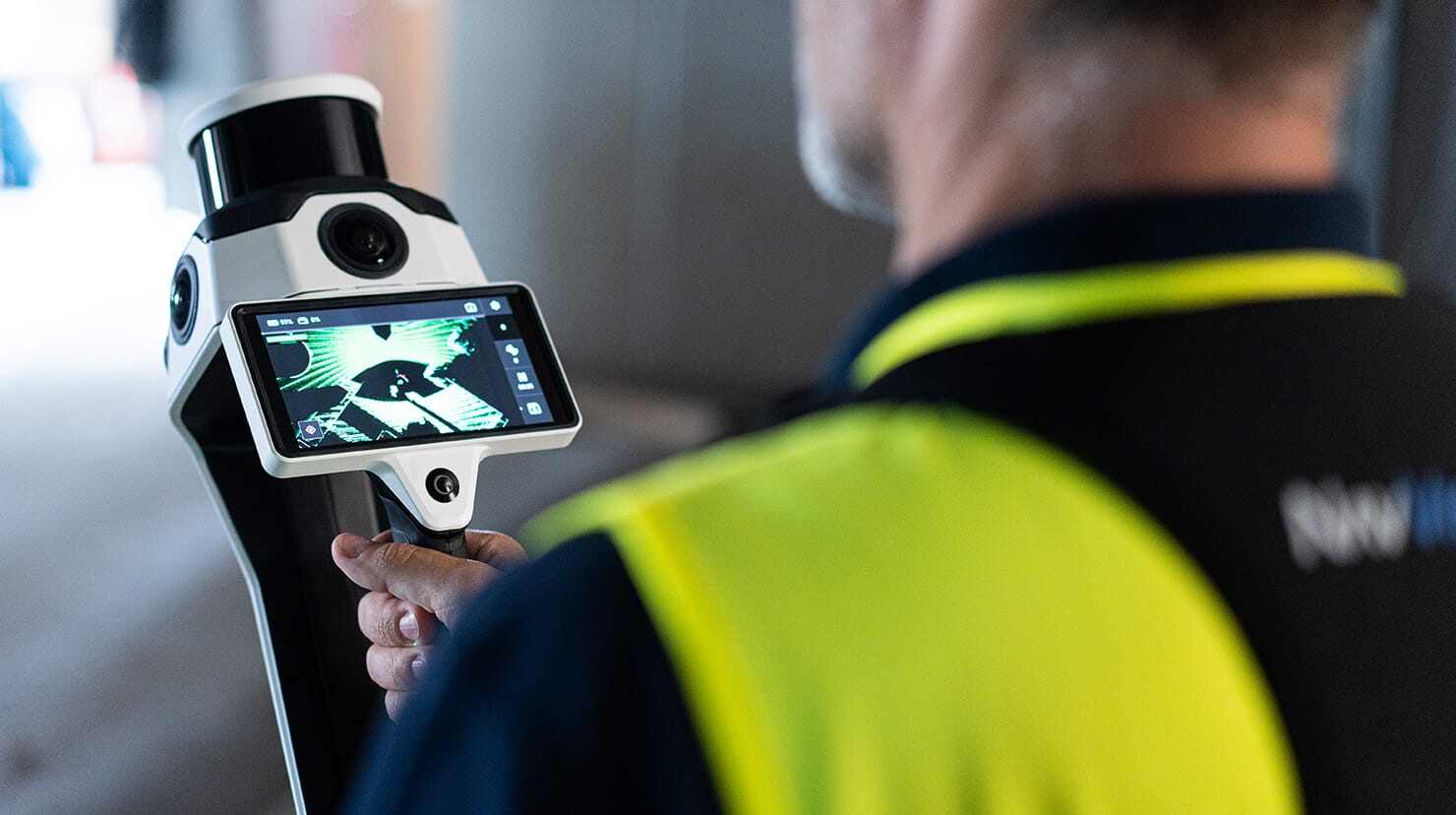
- Method: Mobile SLAM (NavVis VLX 3)
- Complexity: Moderate (furnished offices, conference rooms, open plans)
- Deliverables: Registered point cloud (E57 + RCP), 2D floor plans per floor
- Estimated cost: $25,000 - $40,000
- Field time: 1-2 days
- Total turnaround: 7-10 business days
Example 2: 300,000 sqft Distribution Center
- Scope: Single floor, 40-foot clear height, racking throughout
- Method: Mobile SLAM
- Complexity: Low-moderate (repetitive geometry, limited SLAM features between racks)
- Deliverables: Point cloud, clearance height map, 2D layout plan
- Estimated cost: $30,000 - $50,000
- Field time: 1-2 days
- Total turnaround: 7-10 business days
Example 3: 50,000 sqft Manufacturing Plant (Hybrid)
- Scope: Production floor + mechanical rooms + offices
- Method: Hybrid — mobile SLAM for general areas, tripod for mechanical rooms
- Complexity: High (dense equipment, piping, multi-level mezzanine)
- Deliverables: Unified point cloud, floor plans, detailed mechanical room scans
- Estimated cost: $20,000 - $35,000
- Field time: 2-3 days
- Total turnaround: 10-14 business days
Example 4: 10-Store Retail Portfolio
- Scope: 10 retail locations, 3,000-8,000 sqft each
- Method: Mobile SLAM
- Complexity: Low (open floor plans, standardized layouts)
- Deliverables: Point cloud + floor plan per location
- Estimated cost: $25,000 - $40,000 total ($2,500-$4,000 per store)
- Field time: 1-2 hours per store
- Total turnaround: 2-3 weeks (staggered by location)
How to Get a Quote
Mobile scanning project costs are specific to each building and set of requirements. To get an accurate quote:
- Define the scope. What buildings or areas need scanning? Total approximate square footage? Number of floors?
- Specify accuracy needs. Is 5-10mm accuracy sufficient, or do certain areas require sub-5mm precision?
- List deliverables. What outputs do you need? Point cloud only? Floor plans? Virtual walkthrough? Specific file formats?
- Note access constraints. When can scanning happen? Are there security, safety, or scheduling restrictions?
- Request a quote. Providers will typically respond with a proposal within 1-2 business days for standard projects.
THE FUTURE 3D provides free project consultations and quotes for mobile SLAM scanning projects of any size. Request a quote to get started.
Frequently Asked Questions
Why is there such a wide price range for mobile scanning?
The range reflects the diversity of project types. A simple 20,000-square-foot open warehouse costs far less than a complex 20,000-square-foot hospital with dense interior partitions, mechanical spaces, and access restrictions. Per-sqft rates also decrease with project size due to economies of scale.
Is mobile scanning always cheaper than tripod scanning?
For projects over about 10,000 square feet, mobile scanning is almost always less expensive — typically 40-60% cheaper. For very small projects (single rooms, small areas under 5,000 sqft), the cost difference narrows because mobilization is a fixed cost regardless of scanning method. In those cases, the accuracy advantage of tripod scanning may justify the small additional cost.
Are there hidden costs beyond the quoted price?
Reputable providers quote all-inclusive project pricing. Potential additional costs to ask about: travel expenses for remote locations, after-hours premiums for night/weekend work, additional deliverable formats beyond the base scope, and IVION or virtual walkthrough hosting fees (which may be subscription-based).
How do I budget for a scanning project I have not scoped yet?
For early budgeting, use $0.30-$0.40 per square foot as a planning estimate for standard commercial mobile scanning. This lands in the middle of the typical range and accounts for average complexity. Adjust upward for industrial/complex facilities and downward for simple open spaces.
Does the scanning provider charge for travel?
Most providers include travel within their standard service area. For projects outside the service area, travel expenses (airfare, hotel, per-diem) are typically added. Some providers have fixed mobilization fees for out-of-market work. Always ask about travel costs during the quoting process.
Can I reduce costs by providing my own survey control?
If your project requires georeferencing (tying the scan to a real-world coordinate system), providing existing survey control points can save time and cost. The scanning provider will not need to establish their own control, reducing field time by several hours. However, the provided control must be accurate and well-documented.
What payment terms are typical?
THE FUTURE 3D requires upfront payment before project commencement. Deposits (typically 50%) are collected at project confirmation, with the balance due before final deliverable release. Credit cards and ACH transfers are accepted.
Ready for a project-specific cost estimate? Get a quote from THE FUTURE 3D. We deploy mobile SLAM scanning technology for projects ranging from single buildings to multi-million-square-foot campuses. See our 3D scanning cost guide for a broader overview of scanning costs across all methods, or learn about our NavVis VLX 3 mobile mapping system.
Ready to Start Your Project?
Get a free quote and consultation from our 3D scanning experts.
Get Your Free Quote